Why use an interferometric laser encoder?
The laser encoder is the highest performance technology used for precision position feedback. It offers the finest resolution and highest accuracy. In comparison, optical and magnetic encoders provide different levels of robustness and measurement performance for a range of less demanding applications.
Why use Renishaw laser encoder systems?
Point of interest measurement
Due to readhead and scale mounting requirements, most linear optical encoders are “buried” inside the positioning stage, some distance away from the workpiece. This distance introduces an additional source of position measurement error known as Abbe error. Interferometric laser encoders have no physical scale and therefore can be installed to directly measure displacement at the point of interest.
Superior wavelength stability
Interferometric laser encoders use the wavelength of laser light as the basic unit of distance measurement. The stability of this wavelength directly influences the repeatability of position measurement. The laser tubes used by Renishaw are referenced against ones certified by the National Physics Laboratory (NPL) to ensure that they meet the best wavelength stability standards. This ensures that Renishaw laser encoders deliver excellent repeatability.
| Timeframe | RLU100 | RLU200 | RLU300 |
| 3 seconds | N/A | N/A | < 0.1 ppb |
| 1 minute | < 10 ppb | < 1 ppb | < 0.5 ppb |
| 1 hour | < 20 ppb | < 2 ppb | < 1.0 ppb |
| 8 hours | < 25 ppb | < 10 ppb | < 3.0 ppb |
Intrinsically high resolution
The measurement reference of Renishaw laser encoders is the internationally recognised wavelength of HeNe lasers. At 633 nm, this is a much finer pitch than typical optical encoders which enables Renishaw laser encoders to achieve fine resolution measurement, up to 38.6 pm.
Minimised errors
The innovative design of Renishaw laser encoders employs various advanced technologies to minimise errors from different sources to achieve the highest precision. These technologies include an advanced laser wavelength stabilisation scheme and sophisticated electronic design and optical schemes that enable the lowest Sub-Divisional Error (SDE) of <±1 nm.
Flexible choices of data format
Renishaw laser encoders offer a choice of different output formats, including analogue quadrature signals and digital data formats with a range of different resolution options. This provides flexibility to integrate precision feedback into a range of motion control systems.
Quick to set up and easy to align
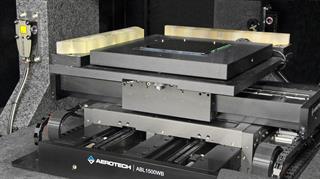
Conventional interferometric laser encoders use a separate laser source, interferometers, steering mirrors, and detector units. The laser beam is routed between these isolated components by a network of beam splitters and benders, resulting in a bulky, complex system which is time consuming and difficult to set up, align and maintain.
Renishaw's RLE interferometric laser encoders use optical fibres to deliver the laser beam directly to detector heads which also contain the interferometer optics and detection electronics. This design delivers several critical advantages that minimise integration time and system complexity:
The system footprint is substantially smaller as the detector head provides the fixed measurement reference with only the mirror mounted onto the motion system.
The laser source and detector head can be mounted remotely from the measurement axis, eliminating heat sources from the working area of the machine.
Complicated beam routing optics are not required as alignment is only needed for the detector head and the moving mirror.
Adjustable beam steerers are integrated into the detector heads, allowing rapid and easy alignment to the axis of motion.
Renishaw's laser encoders provide linear or angular position measurement with high resolution and low cyclic error. Discover more about our range of interferometric laser encoders, their accessories and how they work.
Contact our sales team today
Get in contact with your local office to find out more information and speak to an expert.